Mountain Glacier Evolution Since the Last Interglacial
Mountain glacier evolution since the last interglacial
Pending Final Release for Copernicus Publications (2026)
Co-authored by Sjur Barndon, Augusto C. Lima, David M. Chandler, Abe T. Wiersma, Tancrède P.M. Leger, Raúl Pérez Prats, Eline S. Rentier, and Suzette G.A. Flantua
Research Abstract
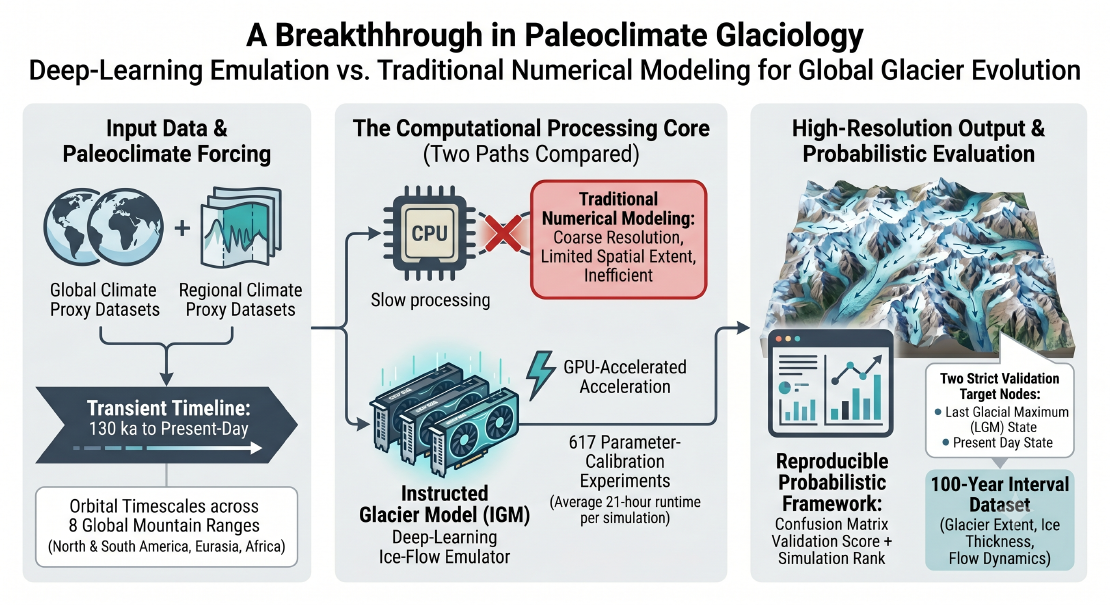
Mountain glacier evolution since the last interglacial remains poorly constrained, with limited spatial and temporal coverage. Conventional modelling approaches typically target major climatic events, operate at coarse spatial resolution over limited spatial domains, or employ simplified representations of ice dynamics.
Here, we address these limitations by applying the Instructed Glacier Model (IGM), to reconstruct, for the first time, mountain glacier evolution since ∼130 ka at 500 m resolution across nine mountain ranges in North America, South America, Eurasia, and Africa. We perform 707 parameter-calibration simulations by varying paleoclimate and ice-dynamic parameters, and validate model performance by assessing glacier extent and ice thickness.
The model outputs are evaluated using a spatial frequency map approach, which identifies a set of acceptable model results rather than a single best-fit simulation. As a result, we identify areas of robust agreement and those sensitive to parameter choices, providing a systematic way to visualise spatial uncertainty and glacier–climate-topography interactions. Together, our framework is a scalable foundation for next-generation, uncertainty-aware reconstructions turning glacier modelling at orbital-timescales into a reproducible, expandable workflow that can be deployed across mountain ranges worldwide.
Open Data & Media Archive
All research data and output animations are publicly available:
- Public Dataset: archive.sigma2.no/dataset/evolution-of-mountain-glaciers-since-the-last-interglacial (Barndon et al., 2026b)
- Visualization Animations: av.tib.eu/series/2022 (Barndon et al., 2026a)
Computational & Geospatial Methods
This research bridges deep scientific computing, machine learning, and geospatial data wrangling at an extreme scale:
- Deep Learning Ice-Flow Emulation: Utilizing the Instructed Glacier Model (IGM), which replicates complex Blatter-Pattyn ice dynamics through a neural network emulator to bypass heavy numerical differential equations.
- Massive GPU Parallelization: Emulation enables transient, high-resolution calculations over 130,000-year orbital timescales that would be computationally impossible with standard CPU-based numeric solvers.
- Spatiotemporal Data Regionalization: Downscaling heterogeneous paleoclimate proxy datasets across nine mountain ranges on four continents.
- Spatial Frequency Map Evaluation: A reproducible parameter-evaluation pipeline of 707 simulation runs using a spatial frequency map approach to identify sets of acceptable model results, mapping spatial uncertainty and glacier-climate-topography interactions.
How to Cite
Barndon, S., Lima, A. C., Chandler, D. M., Wiersma, A. T., Leger, T. P. M., Pérez Prats, R., Rentier, E. S., and Flantua, S. G. A.: Mountain glacier evolution since the last interglacial, Copernicus Publications (Pending Final Release), 2026.