Global Variability in LGM Cooling Affects Biome Reconstructions
Global variability in LGM cooling amongst paleoclimate datasets affects biome reconstructions in mountains
Published in Frontiers of Biogeography (2025, Vol 18, e135871)
Co-authored by Eline S. Rentier, Julien Seguinot, Ondřej Mottl, L. Camila Pacheco-Riaño, Abe T. Wiersma, John-Arvid Grytnes, Lotta Schultz, and Suzette G. A. Flantua
Key Findings & Highlights
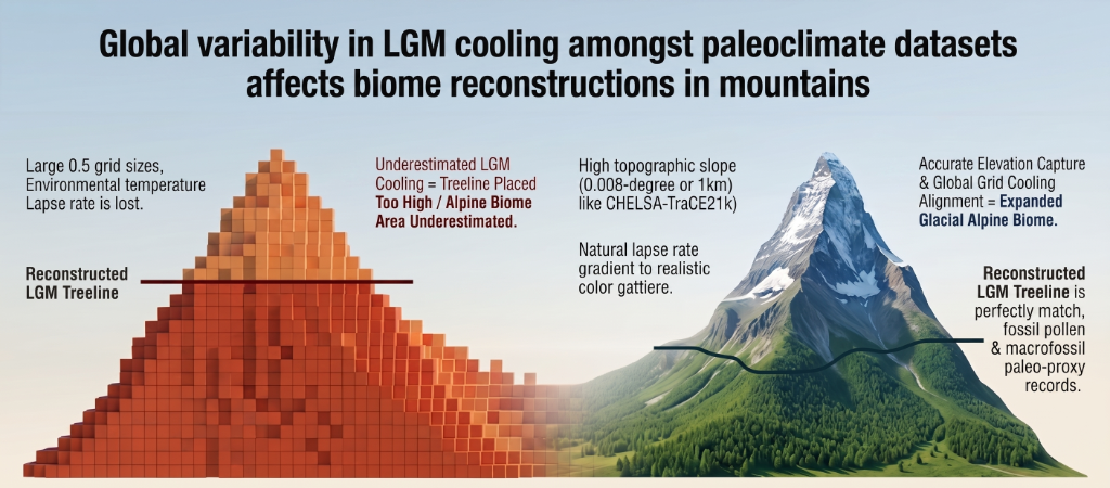
- Dataset Discrepancy: LGM cooling is globally both over- and underestimated by downscaled paleoclimate datasets, causing substantial errors in LGM treeline elevation and mountain biome boundary reconstructions.
- Elevational Variances: Reconstructed LGM treeline elevations differ by 288 to 2,779 meters depending purely on the choice of paleoclimate dataset.
- Topographic Limitations: The spatial resolution of several popular downscaled datasets is mathematically unsuitable to capture localized temperature lapse rates in mountainous regions.
- Mountain Bias: The median temperature difference between paleoclimate models and proxy records is significantly larger within mountain ranges than in lowlands.
- Hypothesis Impact: Paleoclimate dataset selection has a profound impact on downstream biogeographical hypotheses, range shift models, and ecological conclusions.
Research Abstract
Downscaled paleoclimate datasets are widely used in biogeographical research, aiding our understanding of past environmental shifts and species’ responses to climate change. Numerous datasets exist, varying in spatiotemporal resolution and underlying methodologies, resulting in variation in estimated temperature. Understanding this variability is important for accurately reconstructing past biogeographical dynamics, especially in complex regions like mountains.
We compare the Mean Annual Temperature (MAT) at the Last Glacial Maximum (LGM) from five different downscaled paleoclimate datasets — Beyer, CHELSA-TraCE21k, EcoClimate, PALEO-PGEM-series, WorldClim — against MAT estimates from paleoenvironmental proxy records (fossil pollen and plant macrofossils) within and outside mountains. Additionally, we test the performance of a ‘global grid cooling’ method (i.e. lowering local temperatures by a global LGM estimate) against proxy records. Then, we evaluate the implications of inter-dataset variability for reconstructing temperature-delimited biomes in mountains by reconstructing LGM treeline elevations.
We find that LGM temperature cooling and treeline reconstructions strongly vary amongst paleoclimate datasets and between datasets and proxy records. The temperature gradient with elevation is poorly captured by datasets with a coarser spatial resolution. Paleoclimate datasets generally suggest a warmer LGM than proxy records, especially in mountains, while the global grid cooling method more closely aligns with proxy records. Inter-dataset variability can strongly affect the outcome of temperature-delimited reconstructions of biomes and their boundaries, such as treelines. We call for greater awareness and more transparency about the limitations of downscaled paleoclimate datasets in mountainous areas and suggest further research to be aimed at capturing the small-scale heterogeneity of mountains in paleotemperature datasets.
Paleoclimate Concepts & Definitions
- Downscaled Paleoclimate Dataset: A high-resolution climate dataset derived from coarser Earth System Models using statistical or dynamical downscaling to enhance spatiotemporal resolution for ecological studies.
- Earth System Model (ESM): A comprehensive model simulating interactions between the atmosphere, biosphere, oceans, and land-surface using physics-based equations.
- General Circulation Model (GCM): A numerical model simulating ocean and atmospheric circulation on a global scale, typically at a coarse resolution (hundreds of kilometers).
- Regional Circulation Model (RCM): Nested within a GCM to capture localized climate at a much finer spatial resolution (tens of kilometers).
- Global Grid Cooling (GGC): A simplified grid-based cooling approach that offsets modern baseline temperatures uniformly based on a global average LGM estimate (e.g., derived from ice core data).
How to Cite
Rentier, E. S., Seguinot, J., Mottl, O., Pacheco-Riaño, L. C., Wiersma, A. T., Grytnes, J.-A., Schultz, L., and Flantua, S. G. A.: Global variability in LGM cooling amongst paleoclimate datasets affects biome reconstructions in mountains, Frontiers of Biogeography, 18, e135871, https://doi.org/10.21425/F5FBG62827, 2025.